
Inclusion
In accordance with French Ministry of Education guidelines and the requirements of the Dubai Inclusive Education Policy Framework (KHDA, 2017), LLFPM offers all its students equal academic opportunities.
The school is committed to providing quality schooling for all its students, from kindergarten through to high school, taking into account the particularities and special educational needs of each student (exceptional potential, disability, special educational needs, etc.).
The school also operates in accordance with the Inclusive Education Guidelines (KHDA, 2019) and the Directives and Guidelines for Inclusive Education (KHDA, 2020).
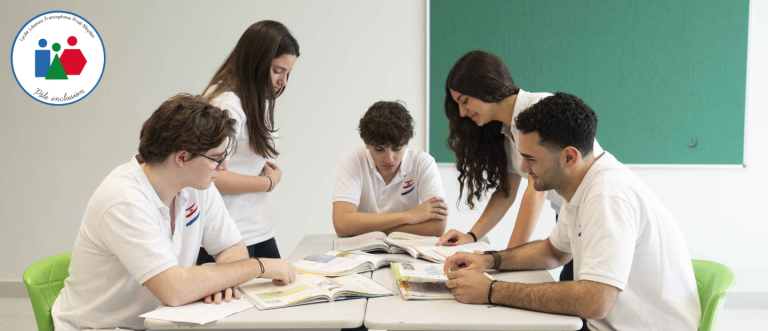
Vision of inclusive education at LLFPM.
The LLFPM is committed to valuing the diversity of all students while promoting individualized learning (individual learners). As a result, our students will have access to quality educational programs that will enable them to develop and realize their academic, social, emotional, and physical potential, within the school environment.
Inclusive schools provide responses adapted to the needs of each student, so that everyone can benefit from equitable educational opportunities.
This inclusive approach also ensures that each student receives occasional or ongoing support throughout their schooling, regardless of their situation: academic difficulties, exceptional abilities, learning disabilities, or specific health needs.
Four systems provide a framework for this reception:
Individualized welcome program
(PAI)
Personalized schooling program
(PPS)
Personalized support plan
(PAP)
Personalized educational success program
(PPRE)
Dedicated inclusion team
Inclusive schooling at LLFPM aims to guarantee conditions of equity between students. To this end, a dedicated team works daily to ensure the well-being of our students. It is made up of two EBEP referents, a speech therapist, and a psychologist.
Educational assessment (CAT4)
CE2 students take the CAT4 test every year. This cognitive skills assessment is designed to help students and their teachers better understand their learning styles and identify their academic potential. This makes it possible to assess the way students reason, with a view to ensuring appropriate pedagogical differentiation.